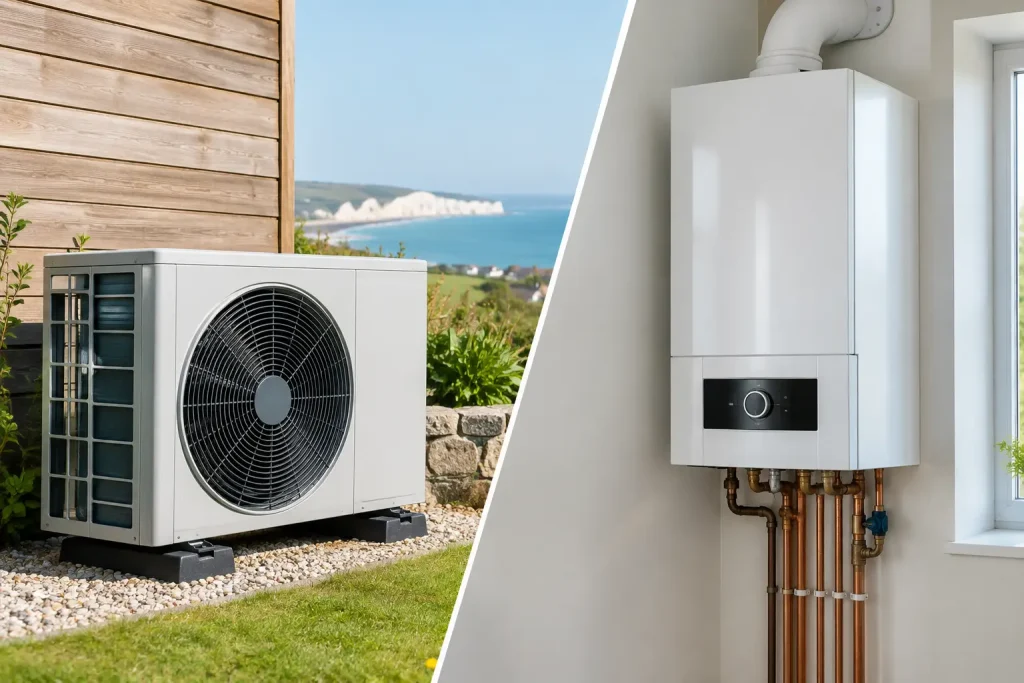
A boiler that has started breaking down just as the weather turns cold creates a difficult decision: pay for another repair, fit a new gas boiler, or invest in a heat pump. When comparing heat pump vs gas boiler costs, the purchase price is only one part of the picture. Your property, radiators, hot-water demand and likely length of stay all affect which option represents better value.
For homeowners in Thanet and across East Kent, a new boiler is normally the lower-cost, quicker replacement. An air source heat pump can make good long-term sense in the right home, particularly where insulation and radiator upgrades have been considered properly. The right answer should come from a clear survey and a like-for-like quotation, not a headline figure alone.
Heat pump vs gas boiler costs at a glance
A straightforward replacement combi boiler installation commonly costs around £2,500 to £4,500. This usually applies where an existing modern boiler is being removed and the new unit can use much of the current pipework, flue position and controls. A conversion from a conventional boiler and cylinder, moving the boiler, or significant changes to the heating system can take the cost to £4,000 to £6,500 or more.
An air source heat pump installation is typically more expensive before any funding is applied. A properly specified system can often fall in the region of £9,000 to £15,000, but larger homes and systems requiring several new radiators, a hot-water cylinder, electrical alterations or outdoor groundwork can cost more.
In England, eligible properties may be able to access support through the Boiler Upgrade Scheme. At the time of writing, this can reduce the upfront cost of a qualifying air source heat pump substantially. The scheme has eligibility rules and requires an MCS-certified installer, so confirm the current grant amount, property requirements and installer status before relying on it in your budget.
A heat pump that appears cheaper than a boiler after a grant may still need work elsewhere in the home. Equally, a boiler quote that looks very low may not include system cleaning, controls or repairs needed to protect the warranty. The detail matters.
What is included in the installation price?
A good boiler quotation should state the boiler make and model, output, warranty, flue work, filter, controls, commissioning and disposal of the old appliance. It should also make clear whether power flushing or chemical cleaning is needed. A modern condensing boiler fitted to a dirty system can suffer reduced efficiency and avoidable faults, so this is not an area to cut corners.
For a heat pump, the survey needs to go further. The installer should calculate the property’s heat loss room by room, check radiator sizes, assess insulation, allow for the outdoor unit position and plan hot-water storage. Heat pumps deliver their best efficiency at lower flow temperatures than gas boilers. That often means some radiators need to be larger, even where the existing system feels adequate with a very hot boiler flow.
There are four common extras that can change a heat-pump budget considerably:
- larger or additional radiators to provide sufficient heat at lower temperatures
- a suitably sized hot-water cylinder, where one is not already in place
- electrical work, isolation equipment and an appropriate supply for the outdoor unit
- pipework, condensate drainage, bases, brackets or landscaping work for the external unit
None of these is automatically a problem. They are simply part of designing a system that will keep every room comfortable rather than fitting equipment around the limitations of the old system.
Running costs: electricity is not the whole story
A gas boiler burns fuel to create heat. Even an efficient modern condensing boiler loses some energy through combustion and the flue, so its seasonal efficiency may be around 90% or better when it is set up and used correctly.
A heat pump uses electricity to move heat from outdoor air into your home. Its seasonal efficiency is measured by its seasonal coefficient of performance, or SCOP. A SCOP of 3 means it provides roughly three units of heat for every unit of electricity used over the heating season.
This makes simple price comparisons misleading. If electricity costs several times more per kilowatt-hour than gas, a heat pump needs a strong real-world SCOP to compete on day-to-day running costs. In a well-insulated home with correctly sized radiators and a suitable electricity tariff, it can perform very well. In a draughty property forced to run at higher temperatures, the savings may be modest or may not appear at all.
Gas and electricity prices change, as do tariffs. Rather than accepting a generic annual saving, ask for an estimate based on your actual energy use, the proposed system design and the temperature your home needs to maintain. If you have solar panels, use off-peak electricity, or expect to improve insulation, these factors can improve the case for a heat pump.
Hot water, comfort and practical differences
A combi boiler provides hot water on demand and does not need a cylinder. For many smaller homes and flats, that is convenient and space-saving. However, hot-water flow can reduce if more than one tap or shower is used at once, depending on the boiler and incoming mains pressure.
Most air source heat pump systems use a cylinder. This takes up space, but it can provide a useful volume of stored hot water for family homes. Recovery is usually slower than a gas boiler, so the cylinder needs to be correctly sized and programmed around household routines.
Heat pumps generally work best when they provide steady, lower-temperature heat for longer periods. A gas boiler can heat radiators rapidly and suits households accustomed to short bursts of high-temperature heating. Neither approach is automatically more comfortable. Comfort comes from correct sizing, sensible controls and a heating system matched to the building.
Lifetime costs, servicing and repairs
A new quality gas boiler may last around 10 to 15 years with annual servicing, clean system water and prompt attention to faults. Annual servicing by a Gas Safe engineer helps maintain safe operation, protects the manufacturer warranty and can identify problems before they leave you without heating or hot water.
A heat pump has no gas combustion or flue, but it is not maintenance-free. Regular checks help protect performance and identify issues with controls, system pressure, filters and outdoor components. It may have a longer potential service life than a boiler, but repairs can involve specialist parts and diagnosis.
The best comparison is the total cost over the period you expect to own the property. Add the installation price, likely servicing, expected repairs, energy use and any planned upgrades such as insulation or radiators. For a homeowner moving within a few years, the lower upfront cost of a boiler may carry more weight. For a long-term home with a good building fabric, a heat pump may justify the extra planning and investment.
Which option suits your home?
A new gas boiler is often the practical choice when an existing boiler has failed, the house has a gas supply, the budget is limited, or the property needs insulation work before a heat pump would operate efficiently. It is also a familiar solution for homes with limited room for a cylinder or an outdoor unit.
A heat pump deserves serious consideration if you are improving insulation, replacing radiators, renovating, or planning to stay in the property for many years. It can reduce reliance on gas and is especially suitable when the whole heating system can be designed around lower flow temperatures from the outset.
Before committing, arrange a proper assessment of your existing system, radiator condition, insulation and hot-water needs. For boiler replacement, use a Gas Safe engineer who will explain the options, provide a clear upfront quote and commission the appliance correctly. For a heat pump, insist on a heat-loss calculation and make sure any grant requirements are addressed before work begins.
The most cost-effective system is the one that keeps your household reliably warm without leaving you with a price, running bill or level of disruption you did not expect. A clear survey now is far cheaper than correcting an unsuitable installation later.


