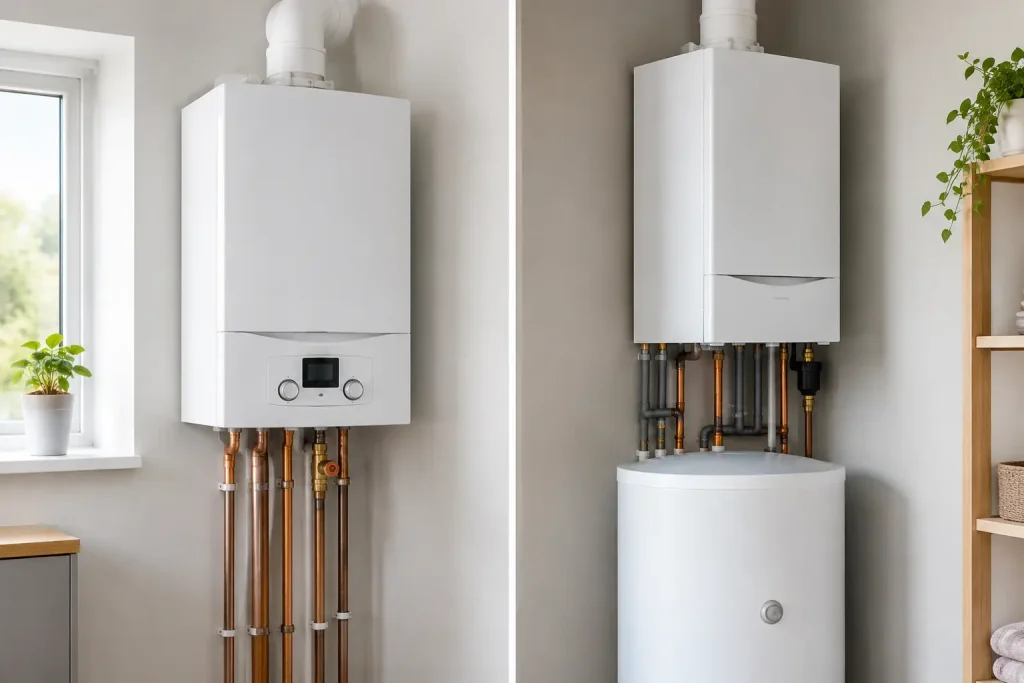
When a boiler is nearing the end of its life, the choice is rarely just about replacing what is already there. The combi versus system boilers decision affects how quickly your household gets hot water, how well showers perform when several people are using them, and how much space the new installation needs. For homeowners across Thanet and East Kent, the right answer depends on the property and the way it is lived in.
A modern boiler from an established manufacturer can improve efficiency and reliability, but only when it is properly matched to the heating and hot-water demand. A Gas Safe engineer should assess the existing system, water pressure, pipework, radiators and future plans before recommending a boiler type.
What is the difference between combi and system boilers?
A combi boiler provides central heating and hot water from one compact unit. It heats hot water directly from the mains when you open a tap or start a shower, so there is no need for a separate hot-water cylinder or cold-water tank. This is why combi boilers are so common in smaller homes, flats and properties where cupboard or loft space is limited.
A system boiler works with a separate hot-water cylinder, usually installed in an airing cupboard or utility area. The boiler heats and stores a supply of hot water, ready for use around the home. Most of the major components are built into the boiler itself, making it simpler than a traditional regular boiler arrangement, which also uses a feed-and-expansion tank in the loft.
The key practical difference is this: a combi produces hot water on demand, while a system boiler stores it for periods of higher demand.
When a combi boiler is the sensible choice
Combi boilers suit many one-bathroom homes in Margate, Ramsgate, Broadstairs and the surrounding area. They are neat, efficient and avoid the heat loss associated with keeping a cylinder of water hot. If two people are not regularly trying to run showers, baths or taps at the same time, a correctly sized combi can be an excellent option.
They can also free up useful space. Removing an old cylinder and loft tanks may create room for storage, which is particularly valuable in smaller houses, bungalows and flats. For landlords, a combi can be a straightforward choice where the property has modest hot-water demand and there is a good mains-water supply.
A combi does have a clear limitation: it can only heat a certain volume of water at any one time. If a shower is running and someone turns on the kitchen hot tap, the flow may reduce. In a busy family home, that can quickly become frustrating. Boiler output matters, but a larger combi alone cannot overcome weak incoming mains pressure or a restricted water supply.
Combis are generally best where there is one bathroom, limited space and a household that does not need several hot-water outlets operating together.
Why a system boiler can be better for larger households
A system boiler is often the stronger choice for homes with two or more bathrooms, multiple regular shower users or a large bath that takes time to fill. Because hot water is stored in a cylinder, it can be supplied to more than one outlet at once without the same compromise in flow that a combi may face.
For example, one person can shower while another uses a hot tap downstairs, or two bathrooms can be used close together. The result depends on the cylinder size, plumbing layout and incoming water pressure, but the stored supply gives a system boiler more capacity for peak demand.
System boilers also work well where homeowners want a powerful shower and have the space to accommodate a cylinder. An unvented hot-water cylinder can provide strong mains-pressure hot water, provided the incoming supply is suitable and the system is designed and installed correctly.
There is a trade-off. Once the stored hot water has been used, the cylinder needs time to reheat. A well-sized cylinder reduces the chance of this happening during normal family use, but sizing is important. Choosing too small a cylinder simply shifts the problem from low combi flow to a depleted stored supply.
Combi versus system boilers: space, cost and efficiency
Space is often the first deciding factor. A combi boiler needs no cylinder, while a system boiler requires one. If an airing cupboard is already in place, keeping or upgrading the cylinder arrangement may be straightforward. If space is tight, fitting a new cylinder may mean changes to cupboards, pipework or the layout of a utility room.
Installation cost can vary considerably. Replacing an existing combi with another combi in the same location is often less disruptive than converting from a combi to a system boiler. A conversion may involve installing a cylinder, extending pipework, fitting controls and making good after the work. Equally, removing tanks and a cylinder to change from an older regular boiler to a combi can involve additional work.
Neither boiler type is automatically more efficient in every household. Modern condensing combi and system boilers are designed to recover more heat from their flue gases than older models. Their real-world performance, however, depends on correct sizing, suitable controls, radiator condition and how the system is commissioned.
A cylinder does have standing heat loss, although modern insulated cylinders are far better than older models. A combi avoids that stored-water loss, but it may not be the most practical solution if the household routinely needs high volumes of hot water. Efficiency should support comfort, not come at the expense of a home that cannot provide enough hot water when it is needed.
Do not overlook your water pressure
Water pressure and flow rate are central to choosing between boiler types. A combi relies directly on the incoming mains supply, so a pressure check alone is not enough. The flow rate – the volume of water available – matters just as much.
A home may show reasonable static pressure but still have insufficient flow for a high-output combi to deliver its full potential. Old supply pipes, shared supplies and local demand can all affect performance. An engineer should measure the supply and explain what it means for your expected shower and tap performance.
A system boiler with an unvented cylinder also relies on a suitable mains supply. Where the supply is poor, the right solution may involve a different system design rather than simply choosing a more powerful boiler. This is why an on-site survey is more reliable than selecting a boiler solely from online specifications.
Think beyond today’s household
It is worth considering how you expect to use the property over the next few years. A couple in a one-bathroom home may be perfectly served by a combi boiler. If an extension, loft conversion or additional bathroom is planned, a system boiler and cylinder may make more sense as part of the longer-term heating design.
The same applies to homeowners replacing radiators or dealing with rooms that never feel warm. A new boiler can only work with the system it is connected to. Before installation, the engineer should assess radiator output, pipework, controls and system cleanliness. Sludge and debris in an older central-heating system can reduce circulation and damage components, which is why power flushing or other cleaning work may be recommended where appropriate.
Smart controls, thermostatic radiator valves and sensible zoning can also make a noticeable difference. They help you heat the rooms you use, at the times you need them, rather than relying on a boiler change alone to solve every comfort or energy-bill concern.
Choosing the right boiler for your East Kent home
There is no universal winner in the combi versus system boilers comparison. A combi is usually the practical, space-saving answer for a smaller household with one bathroom and reliable mains flow. A system boiler is often the better investment where several people need hot water at once, there are multiple bathrooms or future demand is likely to increase.
The best starting point is a clear assessment, not a guess based on the old boiler. At Johnson Plumbing & Heating, a Gas Safe engineer can look at your household demand, available space, water supply and existing heating system, then provide a clear recommendation and upfront quote. A boiler should leave your home warmer, your hot water dependable and your choices properly explained.


